
Share
EV driver's winter guide
Winter has arrived and temperatures are dropping below zero. Many EV drivers, especially before longer trips, wonder how to prepare for colder conditions. The following questions often come up:
How much does cold weather affect range?
How can you maximize range in winter conditions?
What should you do if your EV’s charging port is frozen?
Why is it important to preheat the EV’s battery?
What kind of EV driving can lead to major extra costs?
What else should you remember when driving an EV in winter?
We have collected answers to these questions above, as well as some other useful tips, to help you enjoy a smooth and safe EV winter.


A cozy oasis
Let’s start with some well-deserved praise: EVs are excellent in winter. Many people appreciate how efficiently they heat the cabin. An EV can feel like a cozy oasis on cold days, quickly warming up and making winter driving much more comfortable.
Range decreases
An EV’s range can drop by 20–50% in winter, depending on the weather, the vehicle, and, for example, the condition of the battery. Cold temperatures reduce range, and factors like snow, slush, and wind increase rolling resistance and energy consumption. Air resistance is also higher in winter because cold air is denser than warm air. The exact range loss can vary from day to day depending on conditions. Over time, you’ll learn how your EV performs in different situations.
The good news is that there are steps you can take to save energy and minimize range loss, even in winter. Here are a few tips for optimizing driving style, battery preheating, cabin temperature, and tire pressure.
Smoothly does it
Avoid sudden acceleration and hard braking—drive smoothly. According to some estimates, reducing your speed from 110 km/h to 90 km/h can increase your EV’s range by 10–15%. Also, use your EV’s Eco mode if it’s available. Eco mode helps optimize energy use and reduce the car’s energy consumption.
Preheat the cabin
Avoid overheating the cabin during driving, if you want to extend your car’s range. Heating the steering wheel and seats is more energy-efficient than heating the whole cabin. Also, it’s best to heat the cabin just before you start driving. If the cabin is already warm when you hit the road, it requires less energy to maintain temperature on the road.
Preheat the battery
If you plan to fast-charge along your route, it’s a good idea to preheat your EV’s battery, if your car supports this feature. Without preheating, charging can be very slow when the battery is cold. Check in advance how battery preheating works in your EV. Some models start preheating automatically when you approach a fast charger, if you’ve set the charging station as a stop in your EV’s navigator. Other cars have a physical on/off button, while some allow you to start preheating through the EV’s app. Not all cars currently offer this battery preheating feature.
For fast charging, EVs typically preheat the battery to around 20°C. For example, at 0°C, preheating takes about 40 minutes, while at –30°C it can take up to two hours. Large EV batteries have been compared to sauna stove stones—it takes time for them to reach the ideal temperature.
Drivers aiming for the best charging performance usually arrive at the charging station with as little charge as possible—and with a preheated battery. However, in winter, it’s not wise to wait until the last few kilometers to charge. Maintaining at least a 50-kilometer reserve is recommended to avoid running out of power.
Check tire pressure
Cold air reduces tire pressure, so make sure your EV’s tires are properly inflated, even in cold weather. Low tire pressure increases your EV’s energy consumption, reduces range, makes the car harder to handle, and lengthens braking distances.
Remove ice & snow
Charging plugs, connectors, sockets and ports are designed to be safe even in wet conditions. However, snow or ice in the charging connectors, plugs or sockets can interfere with charging. Visually inspect the charging connector before plugging it in. Shake off snow or ice and wipe the connector if needed. Some EV drivers keep a towel in their car for this purpose. A dry, snow-free connector works most reliably. When you plug it in, make sure you feel it click—this confirms proper connection.
If your EV’s charging port is frozen shut, consider driving the car into a warm garage for a moment to melt the ice. Some experienced EV drivers warm the frozen port with a hot water bottle (warm water in a thick freezer bag) or gently with a hair dryer, on low heat. Do not try to pry off ice with sharp tools or excessive force.
Prevent battery hits
Many people don’t realize that even a small scratch or dent in the EV battery casing can be extremely expensive. Just a minor scrape or cosmetic battery casing damage can sometimes trigger high costs and a need for full battery replacement - due to fire risk concerns, complex diagnostics, and manufacturer policies treating the EV battery as one sealed unit. Therefore, in winter, watch out for snowbanks formed by plowing or deep ruts in the road, and ensure the underside of your car remains undamaged during winter driving. If something serious happens on the road, it’s useful to know in advance how to tow your EV safely without damaging the battery casing.
Charge overnight
In severe cold, don’t leave your EV outside overnight with a low charge. If you have a home charger, plug in your car overnight. With Fortum’s Smart Charging service, your EV charges automatically when electricity prices are lowest, which can save up to 50% on EV charging costs. Smart Charging works with your home EV charger—no extra equipment needed. Smart Charging supports most EV models, and you can check which EVs are compatible (Finland: read more, Norway: read more, Sweden: read more).
A garage or covered parking is the best place to park your EV during freezing weather. If indoor parking isn’t available, choose a sheltered spot, like next to a building or under a carport.
Pack winter gear
It’s a good idea to keep the following winter gear in your EV: a snow brush and ice scraper, snow shovel, flashlight, reflective vest, warm clothes and gloves, first aid kit, rope, and a small bag of sand. Some EV drivers also carry a charging cable for added flexibility at different charging stations.
Add an extra stop
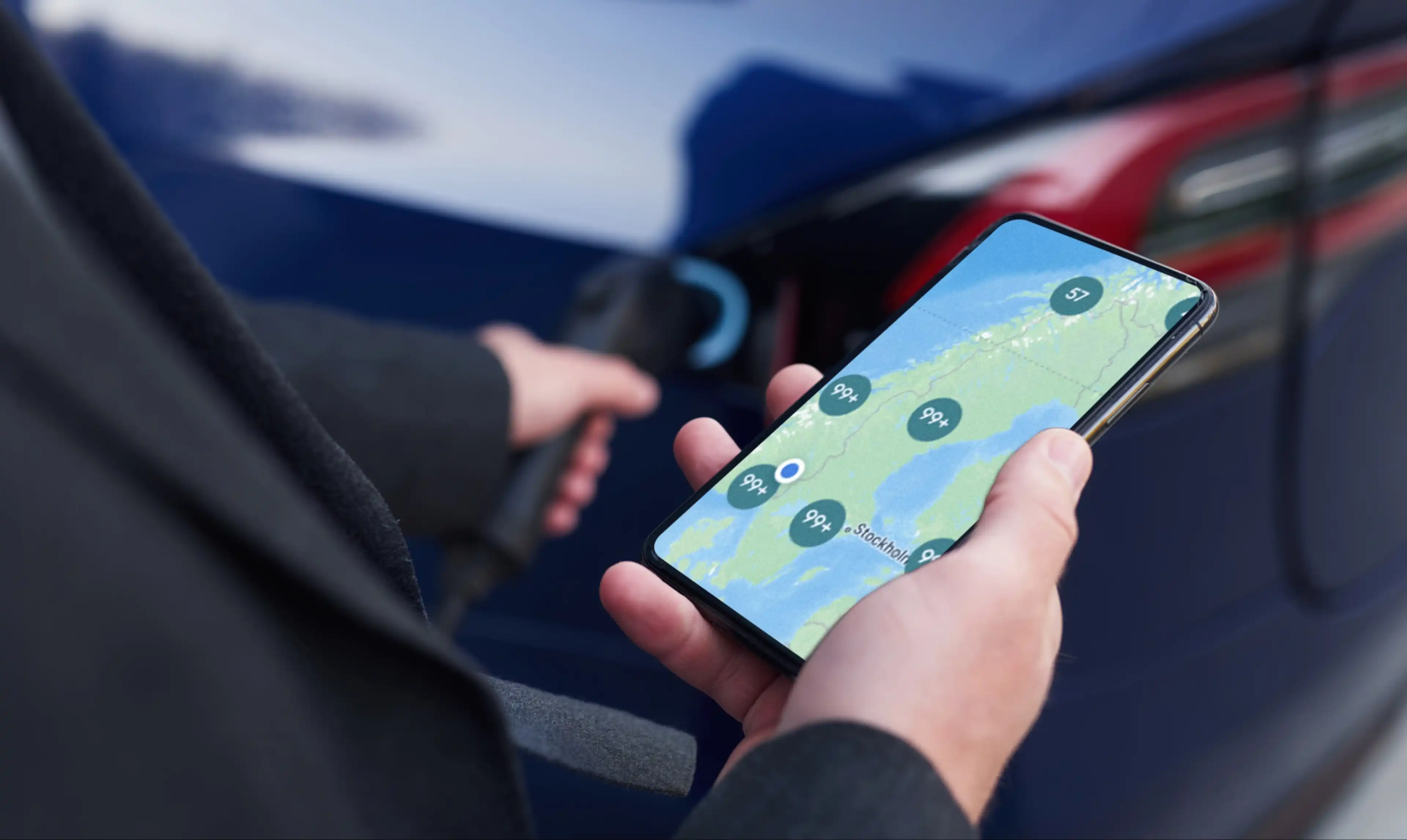
For longer EV journeys, you could add at least one extra charging stop in winter, since the range is shorter than in summer. Use our app’s Route Planner. Through Fortum Charge & Drive you already have access to more than 50,000 in the Nordics (Finland: over 7,000. Norway: over 18,000. Sweden: over 25,000). Among others Recharge, Tesla, IONITY, You will surely find a suitable charging point via us!
Try our charging key
At a charging station, you can use our charging key to start and stop charging, instead of the app. The charging key is especially handy in cold weather—just tap it on the charger’s RFID reader, to start or stop charging. You can easily order a Fortum Charge & Drive charging key through our app.
Charge to 80%
When you stop to charge, charge the battery only to 80%. This saves time and helps extend battery life. Most EVs charge more slowly once they reach 80%, and charging from 80% to 100% often takes longer than charging from 0% to 80%. Before a longer trip, make sure your EV’s battery is in good condition.
Know your EV
In summary: every EV is different. The better you know your own car, the easier winter driving becomes. Plan your route, prepare for an extra charging stop on longer trips, preheat the battery and cabin, and drive smoothly—this ensures seamless EV driving even in winter.
Fortum Charge & Drive team wishes you safe driving this winter! ♥
One app - Multiple charge point operators
Why Fortum Charge & Drive?
One App for All Your Public Charging Needs!
With Fortum Charge & Drive, you can say goodbye to the hassle of multiple charging apps. Get access to 50,000+ charging points across Norway, Sweden and Finland. See real-time prices, plan your routes and check free charges -all with one app!
Ready to charge?
Scan the code to download the app and access chargers locations any time, any where.
You can also download the app from AppStore and Google Play